 Paver Calculator.ORG
How the paver sand calculator works
“Paver sand” means two different things in a paver job: the bedding sand the pavers sit on, and the joint sand swept between them. This calculator is for the bedding layer. For the joints, use the polymeric sand calculator.
- Area. The paved area only. Unlike the base, the sand stops at the edge of the pavers.
- Volume. Area × 1 in ÷ 12. A 12 × 16 ft patio is 192 sq ft, and 192 × 1 ÷ 12 = 16 cu ft.
- Screeding allowance. Some sand is lost to the screed board and to filling small dips. The calculator adds 10%: 16 × 1.1 = 17.6 cu ft.
- Cubic yards, tons and bags. 17.6 ÷ 27 = 0.65 cu yd. At about 1.35 tons per cubic yard that is about 0.88 tons, or 36 bags of 0.5 cu ft.
sand tons ≈ sand yd³ × 1.35
Bedding sand for common patio sizes
At 1 in deep with 10% extra:
| Paved area | Cubic yards | Tons (about) | 0.5 cu ft bags |
|---|---|---|---|
| 100 sq ft | 0.34 | 0.46 | 19 |
| 150 sq ft | 0.51 | 0.69 | 28 |
| 200 sq ft | 0.68 | 0.92 | 37 |
| 300 sq ft | 1.02 | 1.38 | 55 |
| 400 sq ft | 1.36 | 1.83 | 74 |
| 500 sq ft | 1.70 | 2.29 | 92 |
One cubic yard of sand at exactly 1 in covers 324 sq ft. One ton covers about 240 sq ft. Bagged sand is handy for small patios and walkways; for anything much over 300 sq ft, a bulk load is usually less work.
What sand to use under pavers
Ask for coarse washed concrete sand. Its grains are sharp and a mix of sizes, so it drains and holds the pavers firmly once they are compacted into it.
| Sand | Use under pavers? | Notes |
|---|---|---|
| Concrete sand (coarse, washed) | Yes, the usual bedding sand | Drains well, locks up under the compactor |
| Bagged “paver sand” or “leveling sand” | Usually | Check the bag says it is for bedding |
| Mason sand | Not for bedding | Too fine and uniform; can be used in joints |
| Play sand | No | Very fine and round, moves and holds water |
| Stone dust / screenings | Used by some installers | Holds water and can wash out; many paver makers prefer concrete sand |
| Polymeric sand | Never for bedding | Joints only; it hardens when wet |
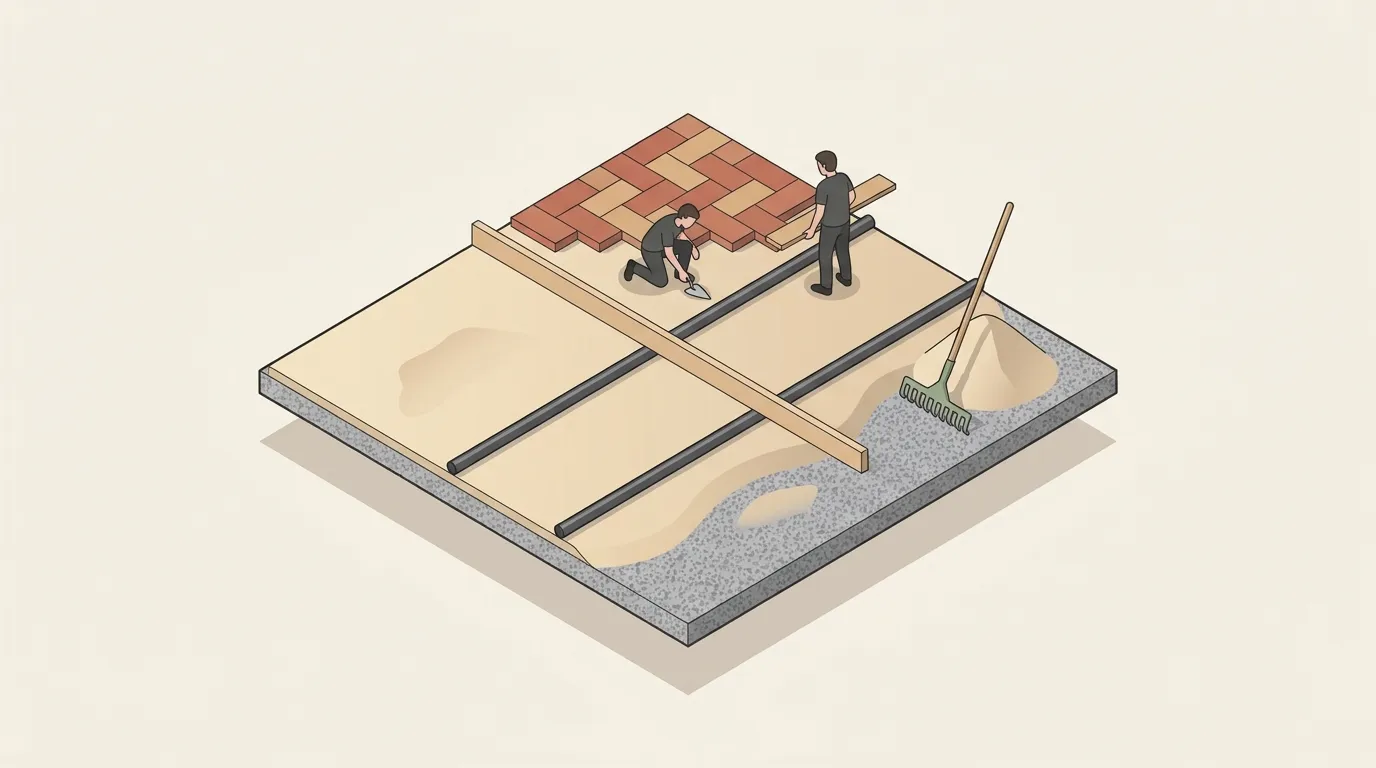
How to screed bedding sand
- Finish the base first. It should already carry the slope and be within about ⅜ in under a 10 ft straightedge. Sand is not for fixing low spots.
- Set screed rails. Lay two 1 in pipes (or 1 in electrical conduit) on the base, parallel and a few feet apart.
- Fill and strike off. Spread sand a little above the pipes and pull a straight board across them to leave a flat 1 in layer.
- Remove the pipes and fill the grooves with a trowel.
- Don’t walk on it. Lay pavers from the pavers already set, working forward onto fresh sand.
- Compact after laying. Run a plate compactor with a pad over the pavers so they settle into the sand, then sweep in joint sand and compact again.
The sand settles to a little under 1 in once the pavers are compacted into it, which is expected.
Leveling sand and “how much sand do I need”
Leveling sand is the same thing as bedding sand. The name trips people up because it suggests sand is used to level the patio. It isn’t: the base does the leveling and sloping, and the sand is a thin, even layer that lets each paver seat. A sand bed thicker than about 1½ in tends to move and rut under foot traffic and much more under cars.
If you also need sand for the joints, the paver sand vs polymeric sand guide explains the difference. The paver base calculator covers the gravel under the sand.
Sand weights vary with moisture. A damp stockpile can weigh noticeably more per cubic yard than dry sand, so if you buy by the ton, buy a little extra or ask the yard to sell by the cubic yard.
Questions people ask
- How much sand do I need for pavers?
- For the bedding layer, multiply the paved area by 1 in (0.083 ft), add about 10 percent and divide by 27 for cubic yards. A 12 x 16 ft patio needs about 0.65 cubic yards, or roughly 0.9 tons or 36 bags of 0.5 cubic feet.
- How thick should the sand be under pavers?
- About 1 in after screeding. Thicker sand beds can shift and rut, so fix low spots in the base rather than adding more sand.
- What kind of sand goes under pavers?
- Coarse, washed concrete sand is the usual choice for bedding. Fine play sand and mason sand hold water and move. Polymeric sand is for the joints only, never for the bedding layer.
- How many square feet does a bag of paver sand cover?
- A 0.5 cubic foot bag, which is roughly a 50 lb bag of dry sand, covers about 6 sq ft at 1 in deep. Allow some extra for screeding.
- How many square feet does a ton of sand cover at 1 inch?
- About 240 sq ft, assuming about 1.35 tons per cubic yard of dry sand. Damp sand weighs more, so a ton covers a little less.