 Paver Calculator.ORG
How the paver calculator works
The calculator does the same takeoff a paver supplier does at the counter, in this order:
- Area. Length × width for a rectangle, 3.1416 × radius² for a circle, and the outside rectangle minus the missing corner for an L-shape. Every section you add is summed.
- Pavers. Area × (1 + extra for cuts) × pavers per square foot. Pavers per square foot is 144 divided by the paver’s length × width in inches.
- Base. The base runs 6 in past the edge of the pavers, so the calculator grows each section by that much, multiplies by the compacted depth, adds 20% because loose crushed base shrinks when you compact it, and divides by 27 for cubic yards.
- Bedding sand. Paved area × 1 in, plus 10% for screeding, divided by 27.
- Polymeric sand. The share of the surface that is joint, times the paver thickness less ⅛ in, times about 100 lb per cubic foot. It is shown as a range of 50 lb bags.
- Edge restraint. The perimeter, less any edge that sits against the house, a step or another hard edge.
base yd³ = base footprint × depth in ÷ 12 × 1.2 ÷ 27
sand yd³ = area × sand in ÷ 12 × 1.1 ÷ 27
Worked example: a 12 × 12 ft patio
A square patio of 4 × 8 in pavers in running bond, 2⅜ in thick, on a 4 in base:
| Line | Working | Result |
|---|---|---|
| Area | 12 × 12 | 144 sq ft |
| Pavers | 144 × 1.05 = 151.2 sq ft × 4.5 per sq ft | 681 pavers |
| Base | (12 + 1) × (12 + 1) = 169 sq ft × 4 in ÷ 12 × 1.2 ÷ 27 | 2.5 cu yd, about 3.8 tons |
| Bedding sand | 144 × 1 in ÷ 12 × 1.1 ÷ 27 | 0.49 cu yd, about 0.66 tons |
| Polymeric sand | about 125 lb of joint volume at ⅛ in joints | 3–4 bags of 50 lb |
| Edge restraint | 2 × (12 + 12) | 48 ft |
| Paver weight | 151.2 sq ft × about 27.7 lb | about 2.1 tons |
If one side of the patio runs along the house, put 12 in the “edge that needs no restraint” box and the edging drops to 36 ft.
Pavers per square foot by size
Paver sizes are sold by their nominal or laying size, which already allows for a normal joint. A 4 × 8 in concrete paver measures a little under 4 × 8 in, and the spacer nibs on its sides hold the joint open so the pattern lays out on a 4 × 8 in grid.
| Paver size | Pavers per sq ft | Sq ft per paver | Pavers for 100 sq ft (no waste) |
|---|---|---|---|
| 4 × 8 in | 4.5 | 0.22 | 450 |
| 6 × 6 in | 4 | 0.25 | 400 |
| 6 × 9 in | 2.67 | 0.375 | 267 |
| 12 × 12 in | 1 | 1 | 100 |
| 16 × 16 in | 0.56 | 1.78 | 57 |
| 24 × 24 in | 0.25 | 4 | 25 |
Many paver lines are sold as a mix of sizes laid in a set pattern, and those are priced and counted by the square foot instead of by the piece. For those, order the square feet from the slip and let the yard turn it into bundles or layers. The how many pavers do I need guide has more worked examples, including multi-size patterns.
How much extra for the pattern
Every pattern needs some pavers cut at the edges. Patterns that run at an angle to the edge need the most.
| Pattern | Extra to order | Why |
|---|---|---|
| Straight or running bond | about 5% | Cuts only at the ends of rows |
| Basketweave | about 5–10% | Cuts where a pair doesn’t fit at the edge |
| Herringbone 90° | about 10% | Zigzag rows leave a cut at most edge pavers |
| Herringbone 45° | about 10–15% | Every edge paver is a diagonal cut |
Curves, circles, inside corners and borders add more. The paver patterns guide shows each pattern and where the cuts fall.
What goes under pavers
A paver surface is only as good as what it sits on. The usual build-up from the bottom:
| Layer | Patio or walkway | Driveway |
|---|---|---|
| Native soil, dug out and compacted | yes | yes |
| Geotextile fabric (on clay or soft soil) | often | often |
| Crushed aggregate base, compacted in 2 in lifts | 4 in (6 in on clay or with hard frost) | 6–8 in, more on poor soil |
| Bedding sand, screeded, not compacted | 1 in | 1 in |
| Pavers | 2⅜ in (60 mm) | 3⅛ in (80 mm) |
| Joint sand or polymeric sand | swept in | swept in |
The paver base calculator explains base depth and what kind of gravel to ask for. The paver sand calculator covers the 1 in bedding layer. For driveways, use the paver driveway calculator, which starts at a deeper base and thicker pavers.
Odd-shaped patios
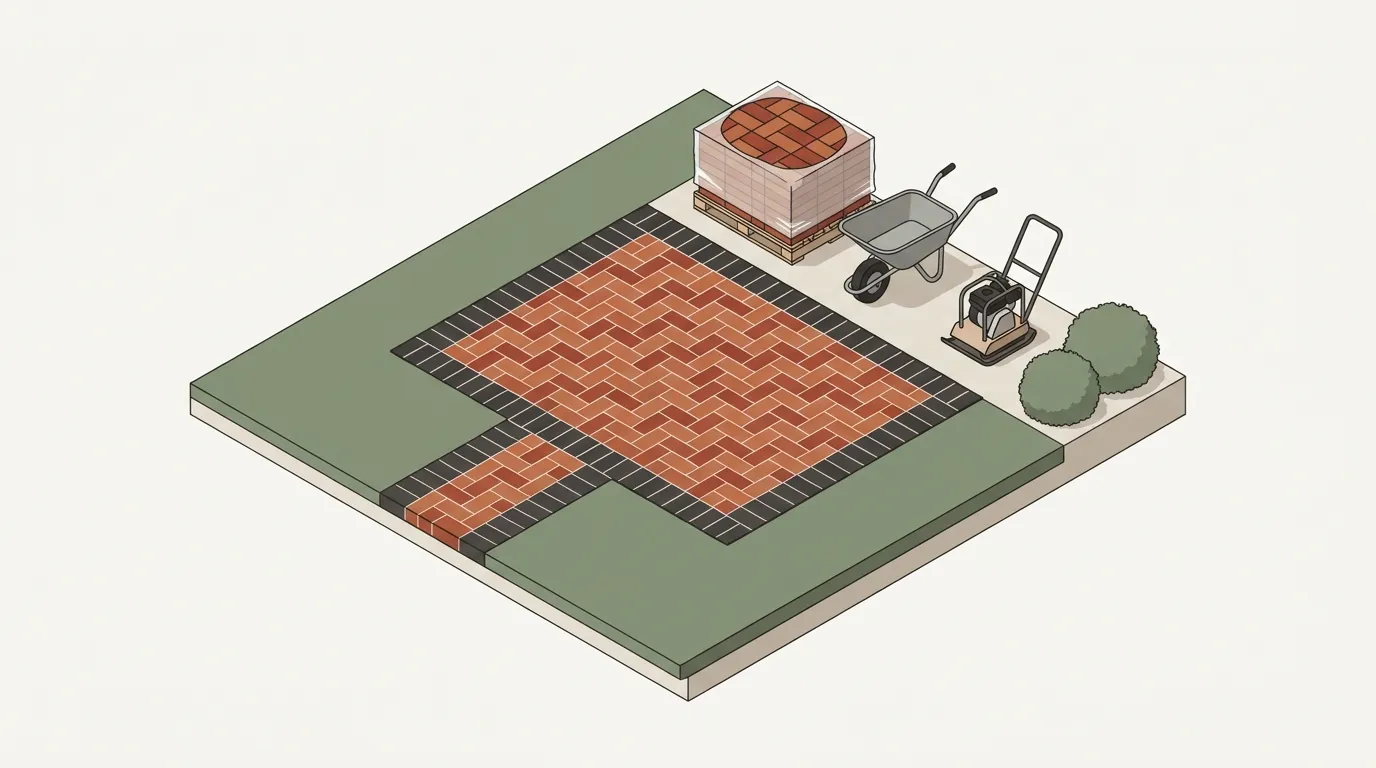
Break the area into simple shapes and add each one as a section. A patio with a rounded end is a rectangle plus a half circle whose diameter is the width of the patio. An L-shape can be entered directly: give the outside length and width, then the size of the corner notch that isn’t paved. A curving path can be entered as several short rectangles.
When sections touch, the calculator counts each section’s full perimeter as edging. Put the shared edge length in the no-restraint box twice (once for each section) and the edging total comes out right. For the rectangle with a half-circle end, that is the patio width × 2.
Before you order
- Ask how the yard sells your paver. Some price by the piece, most by the square foot, and full pallets are often cheaper per square foot than a partial pallet. Ask how many square feet are on a pallet; the paver weight and pallet page shows how to work out pallets and weight.
- Buy the extra now. Pavers from a later production run can differ slightly in color. Keep a few spares for repairs.
- Check delivery weight. A pallet of standard pavers can weigh well over a ton, so plan where the truck can set it down.
The calculator gives estimates. Paver dimensions, base and sand weights and polymeric sand coverage vary by product and supplier. Use the figures on your paver's spec sheet and your sand bag where they differ from the defaults here.
Questions people ask
- How do I calculate how many pavers I need?
- Multiply length by width to get the square feet, add 5 to 15 percent for cuts depending on the pattern, then multiply by the number of pavers per square foot. A 4 x 8 in paver is 4.5 per square foot, so a 12 x 12 ft patio in running bond needs 144 x 1.05 x 4.5 = about 681 pavers.
- How many pavers are in a square foot?
- Divide 144 by the paver's length times width in inches. 4 x 8 in pavers are 4.5 per square foot, 6 x 6 in are 4, 6 x 9 in are about 2.67, 12 x 12 in is 1, 16 x 16 in is 0.56 and 24 x 24 in is 0.25.
- How much base and sand go under pavers?
- For a patio or walkway, about 4 in of compacted crushed base (6 in on clay or in cold climates) and 1 in of bedding sand. Driveways need 6 to 8 in of base or more. The calculator turns those depths into cubic yards, tons and bags.
- How much extra should I order for cuts?
- About 5 percent for straight or running bond, 5 to 10 percent for basketweave, 10 percent for 90 degree herringbone and 10 to 15 percent for 45 degree herringbone. Add more for curves and lots of corners.
- Does the calculator work for odd shapes?
- Yes. Split the area into rectangles, circles and L-shapes, add each one as a section and the calculator adds them up. Where two sections share an edge, type the shared length twice in the no-restraint box so it is not counted as edging.