 Paver Calculator.ORG
How the polymeric sand calculator works
Polymeric sand fills the joints, so the amount depends on how much of the surface is joint and how deep the joints are.
- Share of the surface that is joint. A 4 × 8 in paver laid on a 4 × 8 in grid with ⅛ in joints is really about 3⅞ × 7⅞ in. The joint is the difference: 1 − (3.875 × 7.875) ÷ (4 × 8) = 4.6% of the surface.
- Joint depth. The paver thickness less ⅛ in, because the sand stops just below the top. For 2⅜ in pavers that is 2¼ in.
- Volume and weight. Area × joint share × depth gives the joint volume. Polymeric sand settled into a joint weighs roughly 100 lb per cubic foot.
- Bags. Pounds ÷ 50, rounded up. The high end of the range adds 40% for beveled edges, uneven joints and sweeping losses.
lb = area × joint share × (thickness − ⅛) ÷ 12 × 100
bags = lb ÷ 50 … lb × 1.4 ÷ 50
Worked example
A 12 × 16 ft patio (192 sq ft) of 4 × 8 in pavers, 2⅜ in thick, ⅛ in joints:
- Joint share: 4.64%
- Joint volume: 192 × 0.0464 × 2.25 ÷ 12 = 1.67 cu ft
- Weight: about 167 lb, so 4 bags at the low end and 5 at the high end
The same patio in 12 × 12 in pavers needs about 75 lb, or 2 to 3 bags. The pavers are bigger, so there is far less joint per square foot.
Polymeric sand coverage by paver size and joint width
For 2⅜ in thick pavers. Square feet covered by one 50 lb bag, from the high-usage end to the exact joint volume:
| Paver size | ⅛ in joints | ¼ in joints | ½ in joints |
|---|---|---|---|
| 4 × 8 in | 41–57 sq ft | 21–29 sq ft | 11–15 sq ft |
| 6 × 6 in | 46–65 sq ft | 23–33 sq ft | 12–17 sq ft |
| 6 × 9 in | 55–77 sq ft | 28–39 sq ft | 14–20 sq ft |
| 12 × 12 in | 92–129 sq ft | 46–65 sq ft | 23–33 sq ft |
| 16 × 16 in | 122–171 sq ft | 61–86 sq ft | 31–43 sq ft |
| 24 × 24 in | 183–257 sq ft | 92–129 sq ft | 46–65 sq ft |
Two things stand out. Joint width matters more than anything else: doubling the joint roughly doubles the sand. And small pavers use far more than big slabs, because a 4 × 8 in pattern has more than twice as many feet of joint per square foot as a 12 × 12 in one. Thicker 3⅛ in driveway pavers need about a third more sand than 2⅜ in pavers with the same joints.
Brands differ in grain size and in how they quote coverage, and the chart on the bag is the best guide for that product. Use this calculator to get into the right range before you shop, then check the bag.
Joint width: what to choose
- ⅛ in or less. Standard concrete pavers with spacer nibs, laid tight. Most polymeric sands are made for these.
- ¼ in. Some clay brick pavers, hand-laid patterns without nibs, and older patios once the old sand is cleaned out.
- ⅜ to ½ in. Tumbled pavers with rounded edges, natural stone and large slabs. Many brands make a separate wide-joint product for these.
- Wider than about ½ in. Flagstone and irregular stone. Look for a product rated for wide joints, or use stone dust or a mortar joint instead. The flagstone calculator covers those patios.
How to install polymeric sand
- Start dry. Pavers, joints and sand must be completely dry, and the forecast clear for the time on the bag.
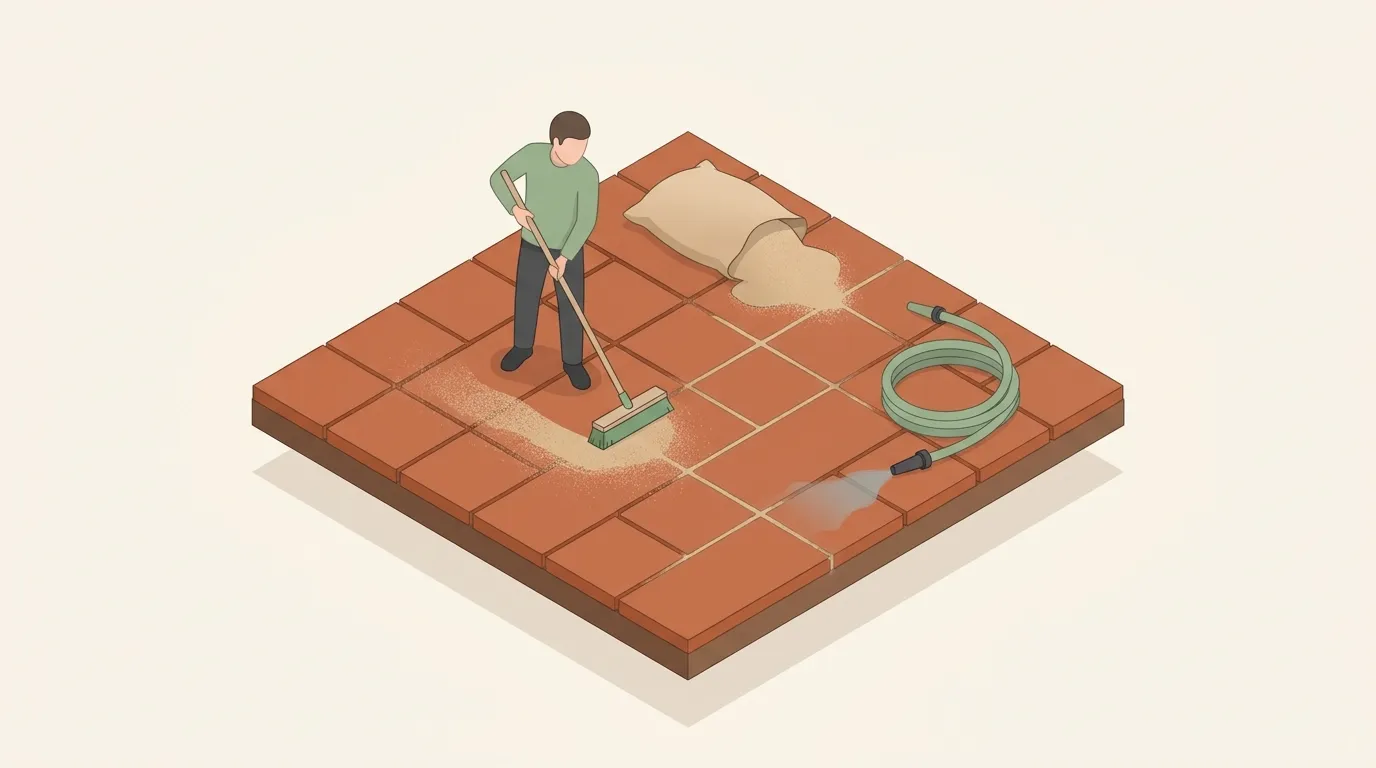
- Sweep it in. Spread the sand and sweep it into the joints from several directions.
- Compact. Run a plate compactor (with a pad) over the pavers to settle the sand, then sweep in more. Repeat until the joints stay full to about ⅛ in below the top.
- Clean the surface. Sweep, then blow off every grain with a leaf blower. Sand left on the face of the pavers can leave a haze once wet.
- Water it as the bag says. Usually a fine mist in stages, enough to activate the binder without washing it out of the joints.
Too little water and the binder doesn’t set; too much and it washes away. Follow the instructions for the brand you bought, because products differ.
Polymeric sand or regular joint sand?
Polymeric sand hardens and resists weeds, ants and washout better than plain joint sand. It costs more and is less forgiving to install. The paver sand vs polymeric sand guide compares the two.
Questions people ask
- How much polymeric sand do I need?
- It depends mostly on joint width and paver size. For 4 x 8 in pavers with tight 1/8 in joints, plan on roughly 1.75 to 2.5 bags of 50 lb per 100 sq ft. Large 12 x 12 in pavers with the same joints need about 0.8 to 1.1 bags per 100 sq ft. Wider joints need several times more.
- How many square feet does a 50 lb bag of polymeric sand cover?
- Anywhere from about 10 to over 150 sq ft. Small pavers with wide joints use the most; large pavers with tight joints use the least. Every brand prints a coverage chart on the bag, and that chart is the figure to trust.
- Why does the calculator give a range?
- The low end is the joint volume worked out exactly. Real joints are wider in places, pavers have beveled edges that also fill with sand, and some sand is lost while sweeping, so the high end adds 40 percent.
- Can I use polymeric sand under pavers?
- No. Polymeric sand is only for the joints. The bedding layer under pavers should be coarse concrete sand, about 1 in thick.
- How deep should polymeric sand be in the joints?
- Fill the joint to about 1/8 in below the top of the paver, or just below the bevel on pavers with chamfered edges, so the hardened sand isn't scuffed off and water can run across the surface.