 Paver Calculator.ORG
How the paver base calculator works
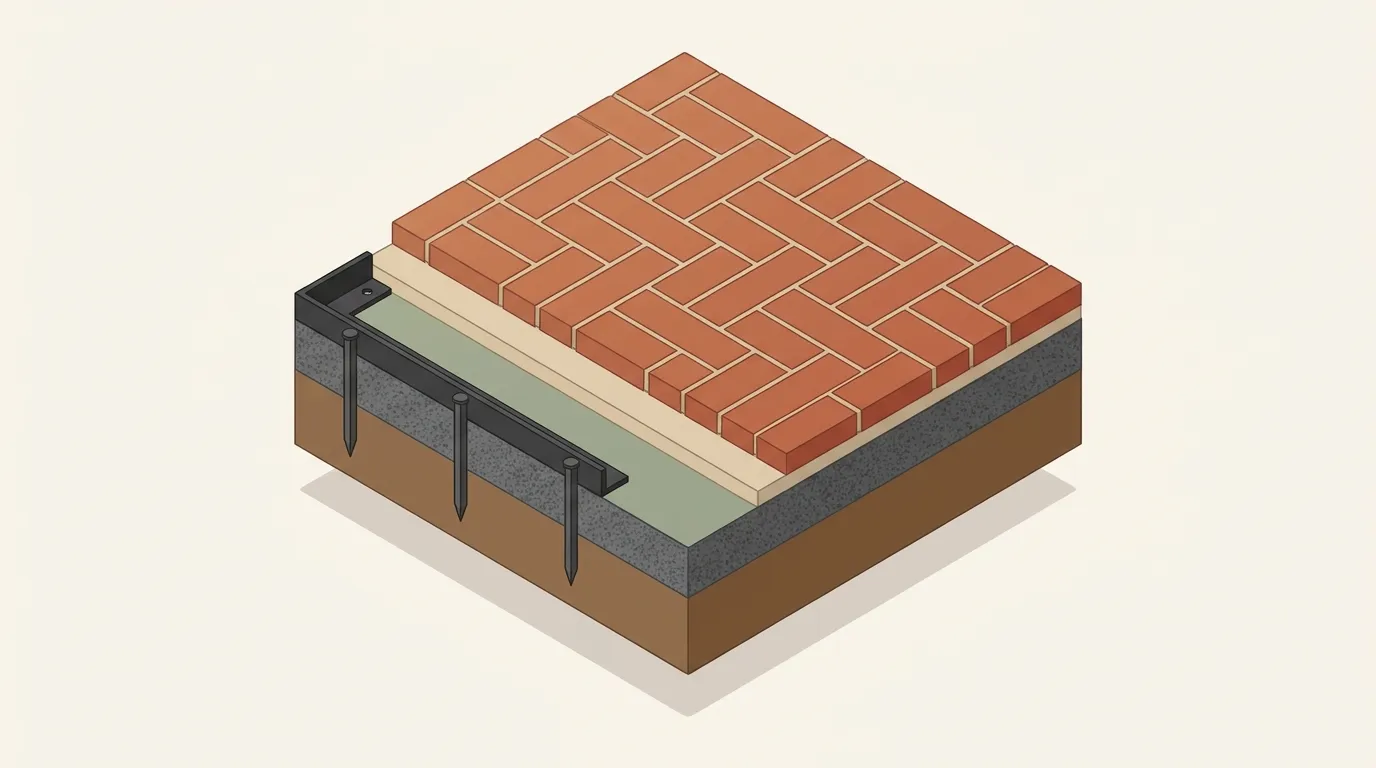
Paver base is the layer that carries the load. Pavers and sand only spread it. Getting the quantity right comes down to three things: the footprint of the base, its compacted depth, and how much the loose stone shrinks when you compact it.
- Footprint. The base should run past the edge of the pavers so the edge restraint and the outer pavers sit on solid ground. The calculator adds 6 in on every side (change it under Base options). A 10 × 16 ft patio becomes an 11 × 17 ft base, or 187 sq ft.
- Compacted depth. Depth in inches ÷ 12 gives feet. 187 sq ft × 4 in ÷ 12 = 62.3 cu ft.
- Compaction. Crushed base arrives loose and loses volume under the plate compactor. The calculator adds 20%: 62.3 × 1.2 = 74.8 cu ft.
- Cubic yards and tons. 74.8 ÷ 27 = 2.77 cu yd. At about 1.5 tons per loose cubic yard that is about 4.2 tons, or 150 bags of 0.5 cu ft.
base tons ≈ base yd³ × 1.5
If your supplier quotes a different weight per cubic yard, use theirs. Damp base weighs more than dry, and a ton of wet stone covers less ground.
How deep should paver base be?
Depth depends on what the surface carries and on the soil under it. Soft, wet or clay soils and hard frost need more base.
| Use | Firm, well-drained soil | Clay, soft soil or hard frost |
|---|---|---|
| Walkway, garden path | 4 in | 6 in |
| Patio, pool deck | 4 in | 6 in |
| Hot tub pad or heavy planters | 6 in | 8 in |
| Driveway (cars, light trucks) | 6–8 in | 8–12 in |
These are compacted depths of crushed base, measured before the 1 in of bedding sand. Dig deep enough for the base, the sand and the paver thickness together: a patio with 4 in of base, 1 in of sand and 2⅜ in pavers needs about 7⅜ in of digging below the finished surface. The paver driveway calculator starts at a deeper base.
Coverage of paver base
| Compacted depth | Sq ft per ton | Sq ft per cubic yard | 0.5 cu ft bags per 100 sq ft |
|---|---|---|---|
| 3 in | about 60 | about 90 | 60 |
| 4 in | about 45 | about 68 | 80 |
| 6 in | about 30 | about 45 | 120 |
| 8 in | about 22 | about 34 | 160 |
| 10 in | about 18 | about 27 | 200 |
| 12 in | about 15 | about 22 | 240 |
The table assumes 1.5 tons per loose cubic yard and 20% compaction, and doesn’t include the extra 6 in past the edges. The calculator adds that for you.
Paver base for common patio sizes
With the base running 6 in past every edge and 20% added for compaction:
| Patio | 4 in base | 6 in base |
|---|---|---|
| 10 × 10 ft | 1.8 cu yd, about 2.7 tons | 2.7 cu yd, about 4.0 tons |
| 10 × 12 ft | 2.1 cu yd, about 3.2 tons | 3.2 cu yd, about 4.8 tons |
| 12 × 12 ft | 2.5 cu yd, about 3.8 tons | 3.8 cu yd, about 5.6 tons |
| 12 × 16 ft | 3.3 cu yd, about 4.9 tons | 4.9 cu yd, about 7.4 tons |
| 16 × 20 ft | 5.3 cu yd, about 7.9 tons | 7.9 cu yd, about 11.9 tons |
| 20 × 20 ft | 6.5 cu yd, about 9.8 tons | 9.8 cu yd, about 14.7 tons |
What to ask for
Paver base goes by different names depending on the region and the quarry: ¾ in minus, crusher run, dense grade aggregate, road base, Class 2 base, quarry process. What they have in common is crushed, angular stone with a range of sizes down to dust. The fines fill the gaps between the larger pieces, and the sharp faces lock together when compacted.
Avoid round stone such as pea gravel or river rock for a standard base. It rolls under load and never firms up. Clean crushed stone with no fines (such as #57) is used under permeable pavers, which are built differently, with open-graded layers that store water. If you are building a permeable system, follow the paver maker’s cross-section.
Laying the base
- Dig and compact the soil. Remove topsoil and roots, shape the subgrade to the same slope as the finished patio, and run a plate compactor over it.
- Add fabric on poor soil. Geotextile fabric between clay and base keeps the two from mixing.
- Place in lifts. Spread the base 2 to 3 in at a time and compact each layer with a plate compactor before adding the next. Lightly damp base compacts best.
- Build the slope into the base. The bedding sand must stay an even 1 in, so the base carries the slope away from the house. See the paver patio slope calculator.
- Check it with a straightedge. Fix low spots in the base, not by adding sand.
Quantities here are estimates. Bulk weights vary by quarry, stone and moisture. If your supplier gives you a weight per cubic yard, put the cubic yards from the slip in front of them and let them convert to tons.
Questions people ask
- How much paver base do I need?
- Work out the area the base will cover (the paved area plus about 6 in all round), multiply by the compacted depth in feet, add about 20 percent for compaction and divide by 27 for cubic yards. A 10 x 16 ft patio on 4 in of base needs about 2.8 cubic yards, or a little over 4 tons.
- How deep should paver base be?
- About 4 in compacted for a patio or walkway on firm, well-drained soil, 6 in on clay or where the ground freezes hard, and 6 to 8 in or more for a driveway. Poor soils under driveways can need 10 to 12 in.
- How many bags of paver base do I need?
- At 4 in deep, plan on about 0.8 bags of 0.5 cubic feet per square foot, so roughly 80 bags for 100 sq ft before the extra width past the edges. Bulk delivery is usually easier and cheaper once you need more than a cubic yard or so.
- What gravel is used for paver base?
- Crushed, angular stone with fines, often called 3/4 in minus, crusher run, dense grade, road base or Class 2 base depending on the region. Round gravel such as pea gravel doesn't lock together and isn't used as a paver base.
- How many square feet does a ton of paver base cover?
- About 45 sq ft at 4 in compacted, 30 sq ft at 6 in and 22 sq ft at 8 in, assuming about 1.5 tons per loose cubic yard and 20 percent compaction. Ask your supplier for their weight per yard.