 Paver Calculator.ORG
How to measure a walkway
- Straight walks: length × width.
- Walks with a turn: split them into straight runs and add each as a section. Where two runs meet, put the shared edge in the no-restraint box twice so it isn’t counted as edging.
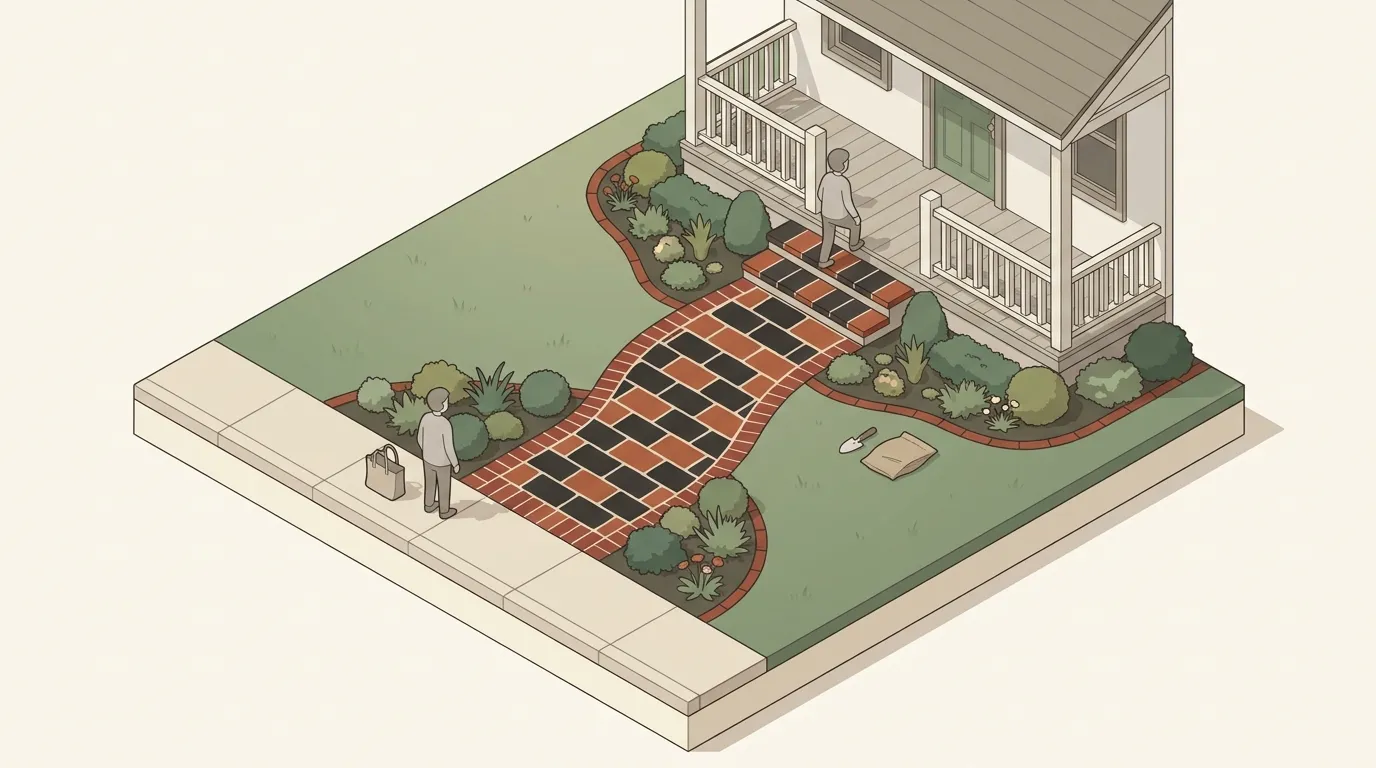
- Curving walks: measure the length along the middle of the path and multiply by the average width. A gentle S-curve 4 ft wide and 30 ft long along its center line is about 120 sq ft. Add 5% more extra for the curved cuts.
- Ends: where the walk meets a step, a porch slab or the public sidewalk, those ends don’t need edge restraint. Add their widths to the no-restraint box.
Worked example: 4 × 25 ft front walk
4 × 8 in pavers in running bond laid across the path, 4 in base, both ends against hard edges.
| Line | Working | Result |
|---|---|---|
| Area | 25 × 4 | 100 sq ft |
| Pavers | 100 × 1.05 = 105 sq ft × 4.5 | 473 pavers |
| Base, 4 in | (25 + 1) × (4 + 1) × 4 ÷ 12 × 1.2 ÷ 27 | 1.93 cu yd, about 2.9 tons |
| Bedding sand | 100 ÷ 12 × 1.1 ÷ 27 | 0.34 cu yd, or 19 bags |
| Polymeric sand | ⅛ in joints | 2–3 bags |
| Edge restraint | 2 × (25 + 4) − 2 × 4 for the ends | 50 ft |
Notice that the base is a bigger share of the job on a walkway than on a patio. The 6 in extension on each side of a 4 ft walk adds 30% to the base footprint (130 sq ft of base under 100 sq ft of pavers), against about 17% on a 12 × 12 ft patio.
Walkway widths that save cutting
Cutting pavers is the slow part of laying a path. If the width is a whole number of pavers, the only cuts are where the walk turns or meets something.
| Paver and layout | Widths that need no cuts |
|---|---|
| 4 × 8 in, running bond across the path | multiples of 8 in: 3 ft 4 in, 4 ft, 4 ft 8 in |
| 4 × 8 in, running bond along the path | multiples of 4 in |
| 6 × 9 in, across the path | multiples of 9 in: 3 ft, 3 ft 9 in, 4 ft 6 in |
| 12 × 12 in | whole feet |
| 4 × 8 in with a soldier course each side | the field plus 16 in |
Borders on walkways
A soldier course (bricks set end-on) down each side gives a walkway a crisp edge and lets you lay a herringbone or basketweave field without the cut pieces showing at the very edge. Count border pavers separately: 3 per foot of edge for 4 × 8 in pavers in a soldier course, 1.5 per foot in a sailor course. The how many pavers guide has a border example.
Pattern and slope for walks
- Pattern: running bond across the direction of travel, or 90° herringbone, both resist the creep that foot traffic causes on long walks. Running bond along the walk tends to look narrow and joints can open over time. See paver patterns.
- Cross slope: tilt the walk about ¼ in per foot to one side so water runs off, or crown it slightly in the middle. On a 4 ft walk that’s about 1 in from one edge to the other. The slope calculator does the arithmetic.
- Running slope: follow the ground, but walks that get steep may need steps. Pavers on a steep grade want a solid edge restraint at the low end.
Paver walkway cost
The calculator above has full price fields. Fill in what your quotes give you and it adds up the job and shows the cost per square foot.
What makes one walkway cost more than another of the same size:
- Length of edge per square foot. A walk has far more edge than a patio of the same area, so more edge restraint, more cuts and more base past the edges.
- Curves and turns. More cutting, more waste and more labor.
- Tearing out an old path. Removing concrete or old pavers and hauling them away is often priced separately.
- Access. A front walk next to the driveway is easy to supply; a back-garden path that has to be wheelbarrowed around the house is slower.
- Steps and landings. Paver steps are built quite differently and are priced by the step.
- Paver choice. Clay brick and natural stone usually cost more than concrete pavers.
The paver patio cost calculator explains how to read a quote and compare installed prices.
Edge restraint matters more on a walkway than anywhere else: with two long edges and narrow width, a walk without restraint spreads within a season or two. See the edge restraint calculator.
Questions people ask
- How many pavers do I need for a walkway?
- Multiply length by width for square feet, add about 5 percent for a running bond pattern or 10 to 15 percent for herringbone or curves, and multiply by pavers per square foot. A 4 x 25 ft walkway in 4 x 8 in pavers needs about 473.
- How wide should a paver walkway be?
- About 3 ft is enough for one person, and 4 to 5 ft lets two people walk side by side. Main entry walks are often 4 to 5 ft wide. Pick a width that is a whole number of pavers to cut down on cutting.
- How deep should the base be under a paver walkway?
- About 4 in of compacted crushed base on firm soil, 6 in on clay or where the ground freezes hard, plus 1 in of bedding sand.
- How do I estimate the cost of a paver walkway?
- Price each part from your local quotes: pavers per piece or square foot, base and sand per ton, edging per foot and labor per square foot. Put them in the calculator to get a total and cost per square foot. Curves, borders, steps and digging out an old path add to it.
- Do walkways need edge restraint on both sides?
- Yes, unless one side is against a wall, a curb or a slab. Without it the outer pavers creep sideways and the joints open up.